HALLUCINOGEN etiketine sahip kayıtlar gösteriliyor. Tüm kayıtları göster

FLASHBACKS

04 Temmuz
FLASHBACKS

The issue of flashbacks, or posthallucinogen perception disorder (PITPD), is clearer. Flashbacks are the reemergence of some aspect of the hallucino­genic experience in the absence of the drug. They are most commonly reported in frequent I.SD users, although isolated case reports exist about flashbacks in individuals after use of other serotonin-like hallucinogens. The most common form includes altered visual images, wavering, altered borders to visual images, or trails of light. While flashbacks can occur after a single use of the drug, they may become increasingly common as the number of hallucinogenic experiences increases. Use of other drugs, like marijuana and alcohol, and even extreme fatigue, can trigger this phenomenon. The overall incidence is hard to judge because use of other drugs or psychiatric conditions must be ruled out. By our best guess, inci­dence for the common user is low.
People's reactions to flashbacks vary widely. Some users experience anxiety and depression while others view flashbacks as an acceptable side effect of an otherwise positive experience. In many cases, flashbacks diminish with abstinence, although symptoms that persist for years have been reported.

Persistent symptoms might actually reflect long-term changes in how the brain processes sensory images. Studies of vision of habitual LSD users (when they are not under the influence of the drug) show that their brains may continue to respond to visual stimuli after the stimuli are removed. This response suggests that repeated LSD usage may cause some neuroplastic changes that persist. In the "Brain Basics" chapter, we dis­cuss the brain's capacity to remember all sorts of experiences, including repeated drug applications.

PHYSICAL AND PSYCHOLOGICAL PROBLEMS

03 Temmuz
PHYSICAL AND PSYCHOLOGICAL PROBLEMS

LSD, psilocybin, and mescaline do not generally cause dangerous phys­ical reactions; and blood pressure, body temperature, and other vital signs remain reasonably stable unless there are acute anxiety reactions. A user is in little danger of seizures or coma. Furthermore, there is lit­tle evidence that these drugs activate the pleasure centers, and addic­tion and physical dependence do not occur. In this sense, they are remarkably safe. However, the psychological consequences for some users can be extreme. The bad trip, in which the drug user feels acute anxiety and perhaps fears that he will not be able to return, is the most common. Fortunately, this reaction ends as the drug is eliminated from the body. Acute anxiety can usually be treated with a dose of a benzodiazepine (a Valium-like drug—see the "Sedatives" chapter). "Talking down" can be helpful, but it is not always practical. While antipsychotic medications like Thorazine (chlorpromazine) were once popular, they are not always effective on bad trips and, in fact, can make things worse. Now that we understand that many hallucinogens act on serotonin-2 receptors, it's possible that an antagonist (blocking) treatment will become available that would terminate the trip immedi­ately. Research studies show that a 5-HT2 antagonist called ketanserin effectively blocks most psychoactive effects of psilocybin. Such drugs exist but have not yet been investigated or approved for this purpose in the United States. Similarly, the narcotic antagonist naloxone should stop a Salvia trip, but this hasn't been tested yet.
What about the myth that taking LSD will make you crazy? Hallucino­gens can worsen the symptoms of people who are already psychotic, but we don't know if they can cause psychosis. They certainly don't very often. However, a number of studies have shown that hallucinogen users are dis­proportionately represented among psychiatric inpatients, and that one to five people out of one thousand who take hallucinogens experience an acute psychotic reaction.
There is a "chicken and egg" problem in understanding this statistic. Most people who are hospitalized for a psychotic reaction to hallucino­gens have never before been seen by a psychiatrist. So, it is impossible to know whether they were completely healthy before the drug experience We do know that a small number of people have very serious reactions to LSD and similar drugs, including prolonged psychotic states. Also, people with a family history of, or other predisposition toward, mental illness should be particularly careful. Sometimes a hallucinogenic experience can bring out symptoms in such individuals

DANGERS AND MYTHS

02 Temmuz
DANGERS AND MYTHS
RESEARCH ON HALLUCINOGENS

One myth we want to dispel is that there is no credible scientific research conducted on hallucinogens. Research on hallucinogens (including LSD) can be legally conducted in the United States and Europe. Admittedly, the research history of hallucinogens is colorful and not always credible, ranging from military experiments on unsuspecting subjects to the blithe self-experimentation of Dr. Timothy Leary in the sixties. However, in recent years, research by credible biomedical researchers has expanded, focusing on a variety of topics ranging from what hallucinogen experi­ences can tell us about psychosis to the specific mechanisms by which these drugs act to cause persevering effects on religious insight.
IDENTIFICATION
Users can never really be sure which hallucinogen they are taking. Blotter-paper-like preparations are most likely to be actual LSD because other hallucinogens are not potent enough for an effective dose to be delivered in this way. However, a pill/capsule/powder could be anything, or any combination of things. Laboratory analyses of blood from people admitted to emergency rooms for LSD toxicity indicate that in some urban settings, only about 50 percent of the drug samples that were thought to be LSD by their possessors actually were LSD. Finally, any drug that has been synthesized in an underground laboratory can contain various by-products that arise from poor chemical synthesis.

Hallucinogenic mushrooms represent another identification problem. It takes an educated and practiced eye to identify any mushrooms in the field, and this is always a dangerous proposition. Many mushroom spe­cies, including the aforementioned Amanita muscaria, contain psycho­active compounds that are extremely dangerous or lethal. Other species (Amanita phalloides, for example) contain toxins that produce fatal damage to the liver and kidneys. While simple "home" tests are much touted ("if the stem turns blue, it is psilocybin"), none of these are fool­proof A number of mail-order operations exist that claim to send out psilocybin-containing mushrooms, but the identity of the spores for "grow your own" operations can be very difficult to establish.

ENLIGHTENMENT OR ENTERTAINMENT?

01 Temmuz
ENLIGHTENMENT OR ENTERTAINMENT?

The use of hallucinogens by many indigenous peoples is tightly controlled by their cultures, which restrict such drugs to ritual use for purposes of healing, enlightenment, or prophecy. In many cases, only particular indi­viduals in a society are permitted to use the drugs at all.
Has the use of hallucinogens evolved from this spiritual purpose to recreational use/abuse in contemporary society? If you talk to college stu­dent users, the reasons they give for using these drugs vary tremendously. Some clearly and simply aim for a novel and exciting experience. How­ever, interviews with regular and heavy users reveal a substantial percent­age who use the drug for the sense of enlightenment they feel they gain by separating from themselves.
The difference between the novelty seekers and those seeking enlight­enment may simply be in how they frame the experience. For example, many users report a sense of "dissolving boundaries" while under the influence: A user might be sitting on the ground and feel that the boundary between the ground and his body no longer exists. This feel­ing could lead to the very exciting (or unsettling) feeling of being sucked into the earth, or it could lead to a calming sense of "oneness" with Mother Earth.
Dr. Timothy Leary (1920-1996) provides an example of varying per­spectives on LSD. He started out as a professor at Harvard, pursuing a traditional academic study of the potential therapeutic utility of halluci­nogens. The stories his subjects told him convinced him that LSD had tre­mendous spiritual value, and he became famous (and lost his job at Harvard) for his advocacy of the free use of LSD. Today he is better known for coining the phrase "turn on, tune in, drop out" during the 1960s than he is for his academic research.

Unfortunately for LSD advocates, their attitudes conflict directly with the illegal status of these drugs. Both sides can argue this issue persua­sively, but the fact is that the majority of Americans prefer that use of such drugs be tightly restricted, as native societies seem to have decided as well. One person's enlightenment can be another person's hell.

BELLADONNA ALKALOIDS

30 Haziran
BELLADONNA ALKALOIDS

The belladonna alkaloids work by a completely different mechanism, which explains the different state that they cause. They act by prevent­ing the actions of the neurotransmitter acetylcholine at one of its recep­tors. Acetylcholine is the neurotransmitter that nerves use to stimulate muscle and allow movement, and it is also the neurotransmitter mim­icked by nicotine. It has two types of receptors: one is stimulated by nic­otine, and the other (called the muscarinic receptor, because researchers discovered that it was stimulated by the compound muscarine from the Amanita muscaria mushroom) slows the heart and probably helps to
form memories. We'll describe this in more detail in the chapter on PCP, KETAMINE, AND DEXTROMETHORPHAN
All three drugs block the actions of the neurotransmitter glutamate at one of its receptors, although PCP and ketamine are much better at it than dextromethorphan. This blockade can, on its own, produce most of the effects of these drugs, including feeling disconnected from your body or environment after either recreational use or medical use in anesthesia. This feeling has made it impossible to use these drugs to treat stroke, a medical use for which there was great hope when the ability of these drugs to limit stroke-induced brain damage was discovered. However, in clinical trials of these drugs, patients hallucinated. As you can imagine, it was terrifying for patients to wake up in the hospital, seriously ill, afraid that the stroke rather than the treatment was causing hallucinations.
PCP and to a lesser extent ketamine act like amphetamine to release the neurotransmitter dopamine. This accounts for the locomotor activation that PCP-intoxicated people can experience. Scientists once thought that these drugs directly affected dopamine neurons, but now they think PCP effects are the result of glutamate receptor blockade. In any case, this causes sonic good feelings and is why both drugs are somewhat addicting.
These drugs also decrease sensations of pain to a varying extent. NMDA receptor blockade likely plays a major role in the effect, but it also may reflect some activity on a group of receptors called "sigma" receptors that when activated cause a spectrum of effects including hallucinations and a loss of pain sensations. These receptors were once classified as opi­ate receptors, but they are not anymore. We do not know what they do in regulating normal brain function. Interest in this system has risen in recent years because researchers found that drugs that specifically stimu­lated this receptor system produced hallucinations without affecting the other opiate systems. Dextromethorphan is also a very weak stimulant of this receptor, which might contribute to its effects.
The most useful drugs are those that are most selective. PCP, ketamine, and dextromethorphan suffer from being the opposite—they block the action of the major neurotransmitter in the brain that excites other neu­rons, and so they affect many important brain functions.

HOW HALLUCINOGENS WORK

29 Haziran
HOW HALLUCINOGENS WORK


Neuroscientists know less about stimulants than most other psychoac­tive medications. To some degree, this is on account of mental trips can be contemplated most accu­rately in people. Nobody would volunteer for the watchful mind injury contemplates that can figure out where basic medication impacts live, however imaging examinations in living people have demonstrated helpful. Also, we do have a considerable measure of data about the neurotransmitter frameworks required from examines in creatures. Since there are such a variety of stimulating medications, it will not shock anyone that there are a few diverse neurochemical courses to hal­lucinatory states and that each medication creates a to some degree particular state caused by an unmistakable component of activity. 

LSD, PSILOCIN, MESCALINE, AND DMT 

The doubt that medications like LSD have something to do with the neu­rotransmitter serotonin (5-HT) has been common since researchers initially depicted the similitude of the synthetic structures of LSD and psilocin to serotonin in the 1940s. It has been a long and convoluted street from this ini­tial doubt to an atomic comprehension of what these medications do. Sero­ton in is an essential neurotransmitter that manages rest, tweak eating conduct, keep up a typical body temperature and hormonal state, and maybe restrain powerlessness to seizures. Medications that improve the greater part of the activities of serotonin are valuable for treating sadness and sup­pressing gorging. How, at that point, can drugs that influence serotonin deliver such odd consequences for observation without disturbing a number of these different activities of serotonin? 

Some portion of the trouble in understanding drugs originated from utilizing LSD as a test psychedelic drug. The greater part of the early test frameworks included organs other than the cerebrum. For instance, serotonin can make the core of a mollusk beat quicker, so these hearts were an early most loved test framework. Researchers would hang the shellfish heart from a wire joined to a pen that would move if the heart muscle contracted. At the point when serotonin was trickled on the heart, it contracted. LSD kept the impacts of serotonin on shellfish hearts and other test frameworks, and for a considerable length of time it was felt that drugs acted by keeping the activities of serotonin. At the point when more advanced trial of serotonin activity in the cerebrum ended up plainly accessible, they appeared to help this thought. Researchers measuring the rate at which serotonin neurons were terminating demonstrated that LSD restrained their terminating. Notwithstanding, this didn't bode well, since closing down the serotonin neurons so significantly ought to have influenced the greater part of alternate procedures that depend on serotonin, however I,SD did not deliver such impacts. Besides, mescaline did not have an indistinguishable impact from LSD in these sorts of investigations, but since the structure of mescaline, not at all like alternate medications, did not look like sero­tonin, researchers were ready to expect that mescaline was working in some extraordinary way. The response to the subject of what psychedelic drugs need to do with sero­tonin needed to sit tight for researchers to find that the neurotransmitter sero­tonin follows up on various distinctive receptors. No less than thirteen sorts of serotonin receptors are currently perceived, and we realize that some appear to have particular impacts on conduct. Just a single of these (as we officially depicted) can trigger mind flights. The thirteen receptors can be gathered into huge classes (1-7), which themselves are subdivided. For all intents and purposes all serotonin-like drugs are agonists (they empower) at two sub­types of the 5-HT2 receptors (5-1-IT2a and 5-HT2c). Analysts feel that the psychedelic action comes about because of the incitement of 5-HT2a. Up until this point, each trial medicate tried that empowers the serotonin-2a receptors causes mental trips. We don't know how this happens, yet we are almost certain that animating these receptors can do it. The greater part of these receptors are in the cerebral cortex, where we think drugs have 

their real activity. 

One puzzle that remaining parts about serotonin drugs is the reason the antidepres­sant drugs that expansion the measure of serotonin in the neural connection (see the "Cerebrum Basics" section) don't for the most part cause mental trips. These medications increment serotonin wherever in the mind, including destinations that have 5-HT2a receptors, yet in spite of the fact that an uncommon patient taking one of these medications encounters mental trips, when the 5-HT2a receptors are animated in adjust with the greater part of the other serotonin frameworks, there are for the most part no 

stimulating impacts.

HALLUCINOGENIC ANESTHETICS

27 Haziran
HALLUCINOGENIC ANESTHETICS


Phencyclidine (PCP, angel dust, etc.) has a bad reputation—and deserves it. Both PCP and ketamine were initially marketed as general anesthetics under the names Sernyl and Ketalar. However, so many patients experi­enced hallucinations and delirium as they were waking up that doctors stopped using it in humans unless they received a Valium-like drug to minimize the hallucinations. Currently, ketamine is used mainly as a veterinary anesthetic. Use in humans is limited to situations in which it is essential to avoid depression of heart function with an anesthetic, or in children. PCP is sold in many different forms: as rocks that are smoked like crack, as PCP-impregnated marijuana joints, as white powder, or as pills. It is taken orally, snorted, or injected intravenously. The main effects of a single dose last four to six hours, although the effects can lin­ger for up to two days. Ketamine is usually obtained by diversion from medical use. It is typically injected, or dried powder prepared from the solution is snorted.
PCP and ketamine are among the most complicated drugs we discuss in this book, because they have so many different effects on brain activ­ity. PCP can produce a state similar to getting drunk, taking amphet­amine, and taking a hallucinogen simultaneously. It is most frequently taken for the amphetamine-like euphoria and stimulation it produces. Many of PCP's bad side effects also resemble those of amphetamine, such as increased blood pressure and body temperature. However, at the same time, it causes a "drunken" state characterized by poor coordination, slurred speech, and drowsiness. People under the influence of PCP are also less sensitive to pain. Finally, at higher doses it causes a dissociative state in which people seem very out of touch with their environment. Observers frequently report that a PCP-intoxicated person has a blank stare and seems very detached from what is going on around her.
Not surprisingly, PCP-intoxicated people frequently find themselves in trouble with the law Their driving skills are poor, their judgment worse, they are not attending to their environment, and they are insensitive to pain. This condition indeed can resemble the "drug-crazed," sometimes violent state that many misinformed people attribute to any drug of abuse. In the case of PCP, the stereotype has some truth. Few drugs cause a person to be more difficult to treat in an emergency room situation because she is so out of touch, belligerent, and agitated. At high doses, muscle rigidity and general anesthesia occur. Extremely high doses can result in coma, seizures, respiratory depression, dangerously high body temperature, and extremely high blood pressure.
Ketamine doesn't have quite the bad reputation that PCP has, perhaps because its stimulatory effects are less pronounced. People who take low doses of ketamine achieve a drunken state—they are a little spacey and uncoordinated, but more sociable. At higher doses, the intoxicated, disso­ciated feeling and loss of coordination get more intense. People describe "going down into a K-hole" to describe the feeling of being cut off from reality. They describe out-of-body and near-death experiences. This dis­sociated state is probably pretty similar to the one induced by PCP. Both of these drugs can cause amnesia, and so users often don't remember the drug experience well.

BELLADONNA ALKALOIDS

26 Haziran
BELLADONNA ALKALOIDS

Belladonna alkaloids are a group of plant-based compounds that affect the central nervous system. They are produced by the plant Datum stra­monium, or Jimsonweed, and other closely related plants of the night­shade family. The name "Jimsonweed" comes from records of a famous poisoning that left the settlers of the Virginia colony of Jamestown deathly ill. Someone unfamiliar with the edible plants of the New World included the leaves of this plant in a salad, resulting in severe intoxication in the diners. The plant became known as Jamestown weed, which later was cor­rupted to Jimsonweed. Teas prepared from any part of the plant, or the chewed seeds alone, produce a bizarre dream state at extremely high doses. Most users do not remember the experience because the drug causes amnesia. Ingesting doses large enough to produce this mental state causes dangerous effects on heart rate, breathing, and body temperature.
The active agents in Jimsonweed are the belladonna alkaloids atropine and scopolamine. Atropine is responsible for many of the effects outside the brain. At low doses, this compound or similar drugs are used to treat asthma and some stomach problems, and also to diagnose eye problems. However, at higher doses atropine can be lethal. The dramatic effects on thought and perception are caused by the scopolamine. Scopolamine, unlike atropine, enters the brain easily and is responsible for all of the behavioral effects of this plant.

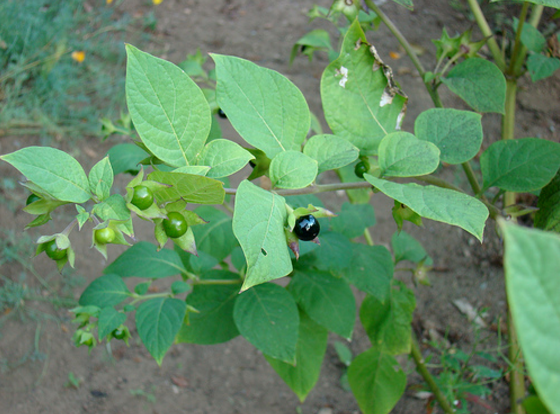
The belladonna alkaloids mimic the complete shutdown of the para­sympathetic nervous system—the mouth becomes dry, the pupils dilate, the heart speeds up, the bronchioles (breathing passages in the lungs) dilate, and digestion slows. These drugs also affect regions of the brain involved in the control of body temperature, which can rise to danger­ous levels. Finally, they block one receptor for the neurotransmitter ace­tylcholine that is important for memory, so users often don't remember the experience. These compounds and related ones also exist in other plants, including the deadly nightshade (Atropa belladonna) and the mandrake root (Mandragora officinarum). Used properly, they are important and effective medicines. They have also been used for divining and other religious purposes by many cultures. However, recent rec­reational use, mainly by teenagers who don't understand the drug's effects, has resulted in an increasing number of hospitalizations and occasional deaths. The mandrake root is showing up in herbal remedies and has caused accidental poisonings in this form.
Belladonna alkaloids have very different actions from the serotonin­related hallucinogens. They induce a bizarre delirium that users remem­ber only as strange dreams. These dreams often include the sensation of
These compounds have been used throughout history, as often for poi­soning as for hallucinations. The term belladonna, or "beautiful woman," comes from their use during the Middle Ages to dilate the pupils of the eyes for the enhancement of beauty. These drugs also were supposedly used by practitioners of female-deity worship in Europe and Eurasia during the rise of Christianity, when those using these drugs were depicted as "witches" by the early Church. These compounds were used in medicine at the time, and it is possible that famous stories of witches flying on broomsticks may derive from vaginal application of these drugs to treat gynecological disorders. Recent news that criminals in Colombia drug tourists with "burundunga," a plant-based drink containing sco­polamine that causes a dissociative state that the victims do not remem­ber, proves that the historic uses of these plants are still with us.

HOW HALLUCINOGENS MOVE THROUGH THE BODY

20 Haziran
HOW HALLUCINOGENS MOVE THROUGH THE BODY

Ritual use of hallucinogens by indigenous peoples involves many routes of administration, ranging from herbal teas to application to the skin to hallu­cinogenic snuffs. However, the major hallucinogens used in the developed world are almost always taken by mouth. All of the drugs listed in the pre­vious section can be absorbed easily from the stomach or intestines. PCP is an exception because users also smoke or inject it. Only LSD is potent enough to be effective in tiny doses absorbed on paper. Users most often simply chew and swallow the plant-derived hallucinogens such as cactus buttons or dried mushrooms. Most hallucinogens, and frequently LSD or various drugs that are supposed to be LSD, are ingested in pill form.
The lag time between taking the drug and beginning the drug experi­ence, and the duration of the experience itself, depends upon the drug. A typical LSD experience begins between thirty and sixty minutes after a user takes the drug. LSD is absorbed efficiently from the stomach and intestines and enters the brain fairly quickly. LSD trips last the longest of typical hallucinogens: the drug effects typically last four to six—but occasionally up to twelve—hours for a single dose. The reason for this is simple: the liver degrades LSD slowly, so active drug remains in the body for hours.
Despite many rumors to the contrary, LSD is not stored in the spinal fluid for months, nor does it remain hidden in any organ. It is elimi­nated just like many other drugs, but more slowly. LSD flashbacks do not occur because hidden drug in the body suddenly reappears. We do not understand the neurobiology underlying flashbacks, but it would be reasonable to speculate that they represent a change in the brain that remains after the drug experience. As we will see later, in the "Brain Basics" chapter, the central nervous system has the capacity to recall all sorts of experiences, and flashbacks may be just that.
Peyote trips can last almost as long as LSD trips. In contrast, psilocybin experiences usually last two to four hours. Dimethyltryptamine (DMT) is the shortest-acting of the commonly used hallucinogens, producing notice­able effects within ten minutes, peaking at about thirty minutes, and end­ing within an hour. This drug is often described as a "businessman's special" for that reason. The differences from drug to drug are caused by differences in two properties. First, the more fat-soluble a drug is, the more quickly it enters the brain (this explains the rapid onset of DMT action). Second, the more slowly the drug gets degraded, the longer the trip. Again, this varies according to the particular chemical structure of the drug. Some drugs, like LSD and mescaline, produce particularly long-lived effects because they are not quickly metabolized by the liver.
PCP deserves some special notice because of the problems its chemical characteristics often cause. PCP is well absorbed when taken by mouth, and peak blood levels are reached even faster (within fifteen to thirty minutes) if it is smoked. However, it is broken down quite slowly, so the effects last a long time. The main drug experience lasts four to six hours, but significant amounts of the drug are present for twenty-four to forty-eight hours. The body's slow metabolism of PCP, along with some users' tendency to use it repeatedly over a day's time, leads to overdose and very persistent drug effects for days after ingestion.
Myths about how to stop a trip abound; drinking milk is the most unlikely we have heard. There is no simple way to speed up the removal of most hallucinogens from the body. Users must simply wait for the liver and kidneys to do their job. PCP is the only exception. In critical situations, emergency room personnel can use a drug that makes the urine more acidic, speeding up the removal of PCP by the kidneys. Some drug treat­ments (see the following) can help with the symptoms of acute panic, and a drug is being tested that could block the action of LSD. However, at the moment there is no quick fix like there is for opiate overdose.
So it's important to remember that, once begun, the trip on some of these drugs can last for hours. If the trip is unpleasant, there is not much to do except receive support from unimpaired companions. If someone is going to experiment with any of these drugs, it is crucial that he or she do so in a safe and supportive environment. Doing even the least dangerous of these drugs alone invites trouble.

WHAT IS A HALLUCINOGEN?

19 Haziran
WHAT IS A HALLUCINOGEN?

Hallucinogens are drugs that change one's thought processes, mood, and perceptions. The word itself is derived from the Latin word cducinare, which means "to wander in mind, talk idly, or prate." At high doses, these drugs cause people to perceive an experience as actually happening when, in fact, it is not. At lower dose levels, they cause milder disturbances of perception, thought, and emotion, but not the complete fabrication of unreal events.

Hallucinogens have often been called psychotomimetics or psychedel­ics. All of these names suggest that these drugs induce or mimic mental illness, but they are wrong to varying degrees. Hallucinogens do not really mimic psychosis or mental illness. Although they can trigger a psy­chotic experience in a vulnerable person, the drug experience itself is probably quite different. For example, the hallucinations caused by most of these drugs are usually seen, whereas the hallucinations of schizophre­nia are usually heard. However, there is some overlap in effects, and recent research with psilocybin has found similarities between hallucinogen effects and some aspects of psychosis, especially feelings of detachment from one's surroundings and feelings of universal understanding. The term psychedelic developed in the late 1950s to describe drugs that were "mind-expanding," a vague term that was popular at the time but not very descriptive. A similar term used to describe these drugs is entheo­genie, which conveys the idea of finding "the god within." None of these terms is completely adequate. The diversity of terminology to describe these drugs almost certainly results from the tremendous variation in the experiences that people have had with them.
This chapter describes three broad categories of hallucinogens. The most familiar is the LSD- or serotonin-like group. The prototype of this group is lysergic acid diethylamide (LSD). Dealers most often package LSD by plac­ing drops of solution onto a piece of absorbent paper (blotter paper) or a sugar cube, although it can also appear in pill form, Psilocybin mushrooms and peyote cacti are also in this category. Psilocybin mushrooms contain the active compounds psilocin and psilocybin, which roughly resemble LSD in the effects they produce. The peyote cactus contains mescaline. Mushrooms containing psilocybin and cactus buttons containing mesca­line are usually consumed as the dried plant, and look like it. There are many other hallucinogens that resemble LSD in their actions, including dimethyltryptamine (DMT) and bufotenine. There is also a group of amphetamine derivatives—including DOM (2, 5 dimethoxy-4-methyl­phenylisopropylamine), also known as STP; TMA (trimethoxyamphet­amine); and DMA (dimethoxyamphetamine)—that resemble mescaline in their actions. Many variations exist and new versions seem to rise and fall in popularity. Other members of this alphabet soup you may encounter are 2C-B (4-bromo-2,5-dimethoxyphenethylamine) and its variants. Many of these hallucinogens appear in pill form, and the actual content of the pills often differs from what the dealer has described. An herbal tea called aya­huasca, containing a combination of DMT and harmala alkaloids, has migrated from South America to the United States.
The second major group of hallucinogens we will discuss are the bella­donna alkaloids. These have been used medically for thousands of years, and ritually for even longer. However, their recreational abuse is just now becoming popular. Belladonna alkaloids in the United States are most often obtained either through prescription medication that contains them or from tea prepared from the leaves of the wild-growing Jimsonweed (Datum stramonium).
The dissociative anesthetics, or "horse tranquilizers," phencyclidine (PCP) and ketamine are the last category. Ketamine is an anesthetic used primarily in children and in veterinary practices. It appears as a solution for injection (that has been diverted from medical use) or as a powder (made from dried-out solution). People usually inject or ingest the solution and snort the powder. PCP appears in several different forms: pills, a pow­der for snorting, or "rocks" that can be smoked or, more rarely, dissolved for injection. Sometimes tobacco, marijuana, or parsley leaves are coated with PCP solution. These produce a bizarre, dissociative state that comes the closest to resembling psychosis of all the hallucinations. Finally, there are two hallucinogens that have unique mechanisms of action, Dextro­methorphan, the main ingredient in many cough syrups, causes a unique, dissociative state at doses higher than those used for cough suppression. Salvia divinorum is a plant hallucinogen that causes an intense, brief, and usually unpleasant hallucinatory experience when users smoke the leaves